 The show begins
The show begins
The show begins
On August 13 he confirmed in his own hand that his U.S. visa had been revoked. On June 11, 2025, when I published that his name headed a list, the U.S. Embassy stamped FALSE across my post. Fourteen months later, the paper arrived. This does not begin with him and does not end with him.
Andrés Manuel López Beltrán confirmed on August 13, 2026, in an open letter dated in Teapa, Tabasco, that the United States government cancelled his visa.
Nobody leaked it. He published it himself, on his own account, over his own signature.
In that letter, addressed to the president of the United States, he holds Secretary of State Marco Rubio and Deputy Secretary Christopher Landau responsible. He calls the decision political, propagandistic and arrogant. And he maintains that no evidence exists against him.
And something happened fourteen months earlier that almost nobody remembers, but that explains everything.
On June 11, 2025 I published a list. The first name was his.
That same afternoon, the official account of the U.S. Embassy in Mexico stamped a red seal across my post with a single word.
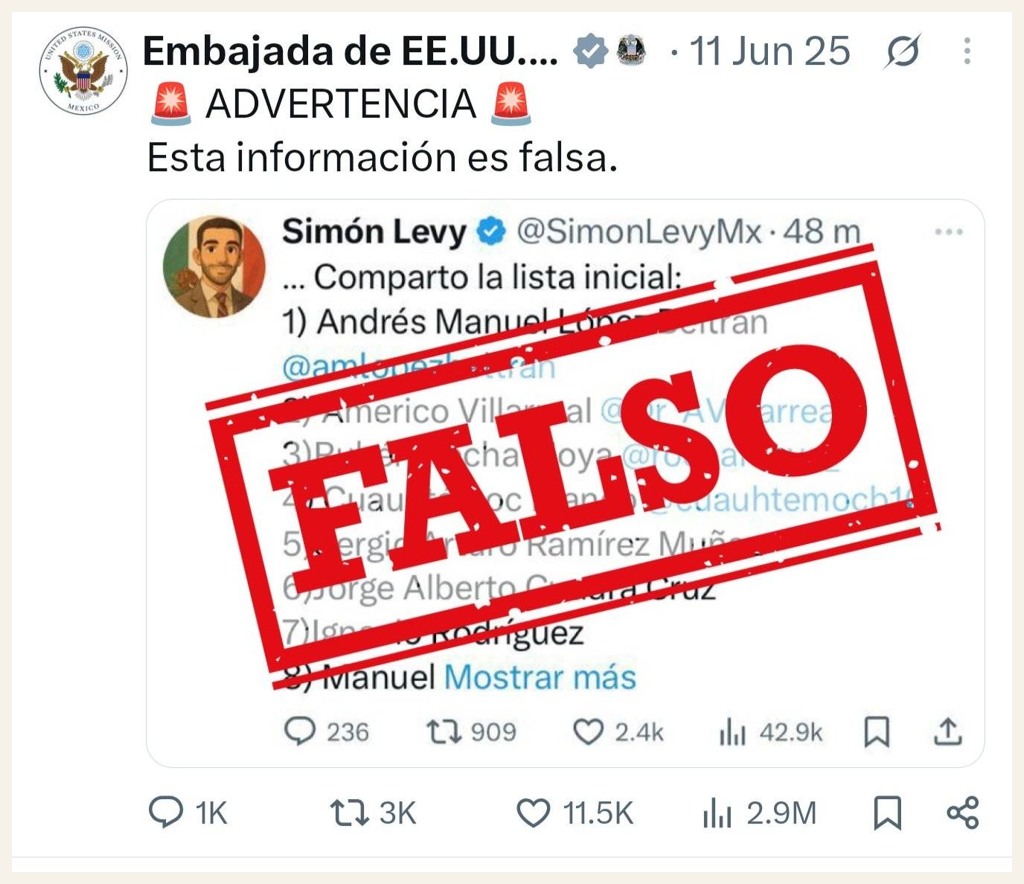
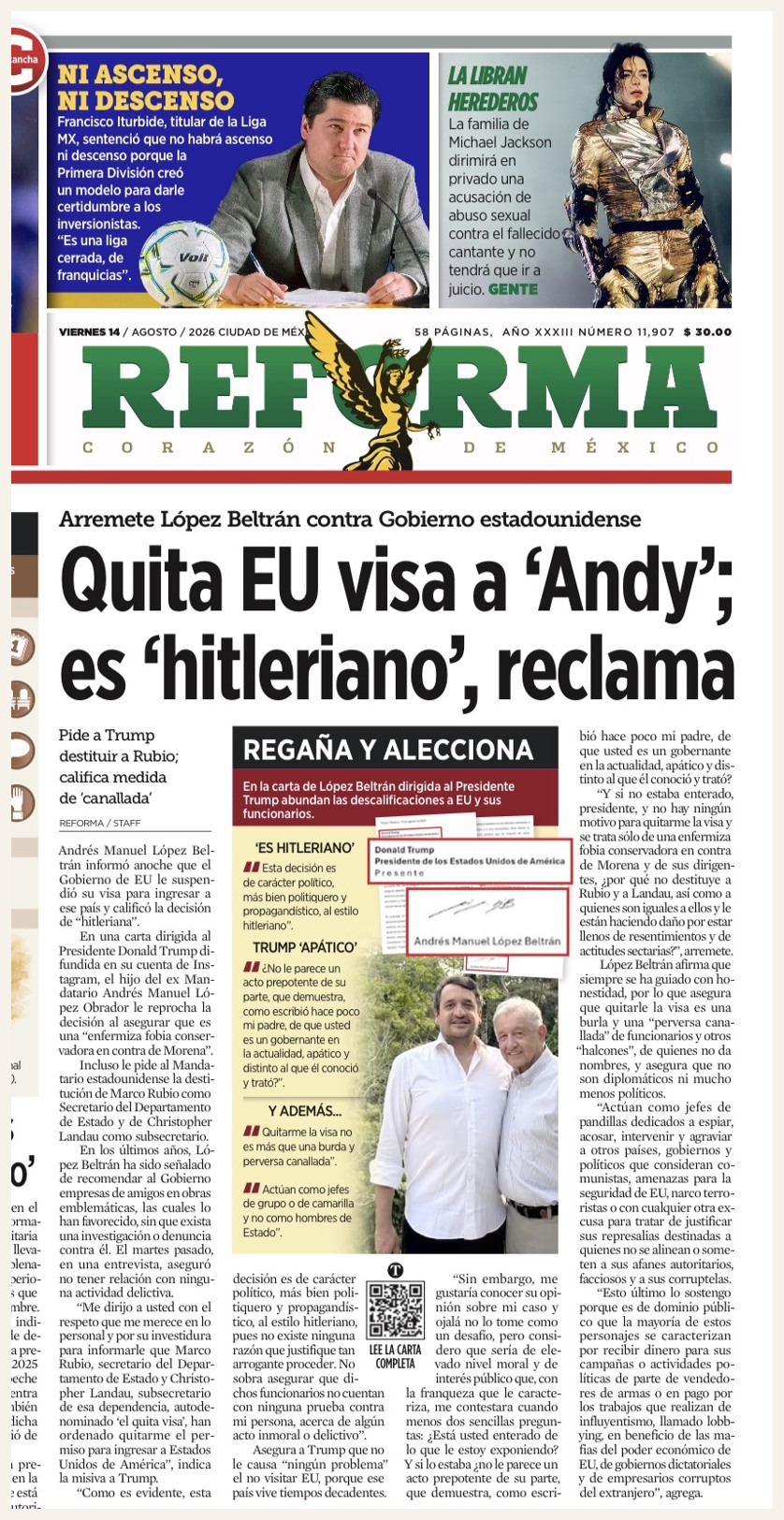
Fourteen months separate one image from the other.
I do not bring this up out of vanity. I bring it up because it establishes the only rule that works for reading what follows: in this file, an official denial has never meant the absence of a case. It has meant the case was not yet public.
And before going further, let me make clear a distinction that will be deliberately blurred in the coming days.
One thing is what is confirmed. Another is what he is accused of. And another still is what I analyze as coming next.
I will keep the three apart from beginning to end. Every allegation in this text carries its level, its source and its date, plus a line stating how far one can go in asserting it.
That is what separates an investigation from a lynching. And it is what keeps a text useful six months from now, once the dust settles.
Without that discipline this would be noise. And there is plenty of noise already.
Now, the question everyone is asking wrong.
Here is the most widespread misreading of these days, and I want to dismantle it before going further.
Almost all public commentary is arguing about whether the revocation was fair or unfair, political or technical, whether the United States has the right or not.
It is the wrong conversation, and here is why in very simple terms.
A visa is not a trial. Nobody loses one by verdict. It is revoked by administrative decision, with no hearing, no defense and no obligation to explain anything. That is why whoever loses one never receives a list of charges: no such list exists, because there was no proceeding.
That means the affected party can always say, with formal justification, that there is no evidence against him. And it is true: there is none in that procedure, because that procedure does not produce evidence.
In the cases I have tracked and dated over two years, revocation has preceded judicial or financial action by margins of months. Not always. But consistently.
Which is why the useful question is not whether it was fair.
The useful question is: what is he accused of, and who is building it?
$4.99 USD
Eight chapters with the documented allegations, the Tabasco network and the applicable statutes.
Unlock · $4.99